

🇧🇬
14.04.2026
Чудвсен е и удължава и уеднаквява живота на батериите.
Only 1 left!
Price of goods is 48,17 €.
Price without tax is 39,81 €.
Actual in cart 0 pcs.
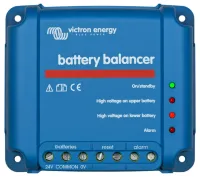
The life of the battery bank can be significantly shortened by the charging imbalance of the individual batteries. This is a situation where you have series or series-parallel 12 V batteries (not just parallel!). In such a system, a single 12 V battery with a slightly higher internal resistance can cause under-charging to full state in parallel batteries and over-charging in series batteries. New battery cells or whole batteries arranged in series have almost identical initial characteristics. Their slight differences are equalized during the absorption or equalization phase of charging. But large differences can lead to excessive gassing caused by overcharging in more charged batteries and unwanted sulphation of less charged batteries caused by not charging to full state.
The solution is balanced charging using a battery balancer. It balances the state of charge of two 12 V batteries connected in series or several parallel rows of batteries connected in series. As soon as the charging voltage rises above 27.3 V in a 24 V system, the battery balancer is activated and compares the voltage of the two batteries connected in series. The balancer can redirect a current of up to 0.7 A from one battery (or batteries connected in parallel) with a higher voltage to the other battery. The result of the different charging current is the same final state of charge of all batteries.
Battery balancers can also be arranged in parallel for more complex systems. With 48, a total of three balancers are used in the system (see diagrams).
In the standard state it is open (inactive). It is closed (activated) when the red LED lights up, i.e. when the voltage difference between the batteries is higher than 0.2 V. As soon as the red LED goes out, the relay opens (deactivates) again (the drop in the voltage difference between the batteries is less than 0.14 V).
The alarm can be switched off by interconnecting the outputs marked as RESET. This can be done using a switch.
The balancer is ready for operation. If the voltage on any of the monitored batteries (string) rises above 27.3 V (during charging), the green LED will light up, indicating that the balancer is activated. If in this situation the deviation of the batteries (strings) is greater than 50 mV, active balancing begins, i.e. compensation of the difference of the batteries (strings). If the deviation reaches 100 mV, one of the orange LEDs is activated. A deviation greater than 200 mV triggers the alarm relay. For series-parallel arrangement of batteries, the intermediate connecting wiring between the parallel rows must be sized to handle the relevant current if part of the battery is disconnected.
Balancer Activation Voltage Level: 27.3V ±1%
Balancer Disable Voltage Level: 26.6V ±1%
Power consumption in disabled state: 0.7mA
Power consumption in activated state: 50 mV
Maximum balance current: 0.7 A at deviation of 100 mV and more
Voltage deviation to trigger alarm: 200 mV
Voltage deviation for turning off the alarm: 140 mV
Method of turning off the alarm relay: connecting two outputs marked as RESET
Protection against overheating: yes
Operating temperature range: -30 to + 50 °C
Maximum humidity: up to 95% (non-condensing)
Cover color: blue (RAL 5012)
Degree of protection: IP22
Weight: 0.4 kg
Dimensions: 113 x 100 x 47 mm
| Name | Value |
|---|---|
| Weight, brutto [kg] | 0,4 |
| Dimension [mm] | 113 × 100 × 47 mm |
| Maximum operating temperature [°C] | 50 |
| Minimum operating temperature [°C] | -30 |
| Type of accessory | battery balancer |
| Connector | terminal block |
🇧🇬
14.04.2026
Чудвсен е и удължава и уеднаквява живота на батериите.